People always say it’s important to save, but have you ever felt a bit lost about what to save or how to save? I have! There are some rules of thumb, like you should save 3 to 6 months of expenses and I think these are EXTREMELY helpful. However, I think there are some additional concepts that are also very important, but tend to get left out of the conversation. As such, here is a relatively brief overview of how we approach savings at wellbeingGrant!
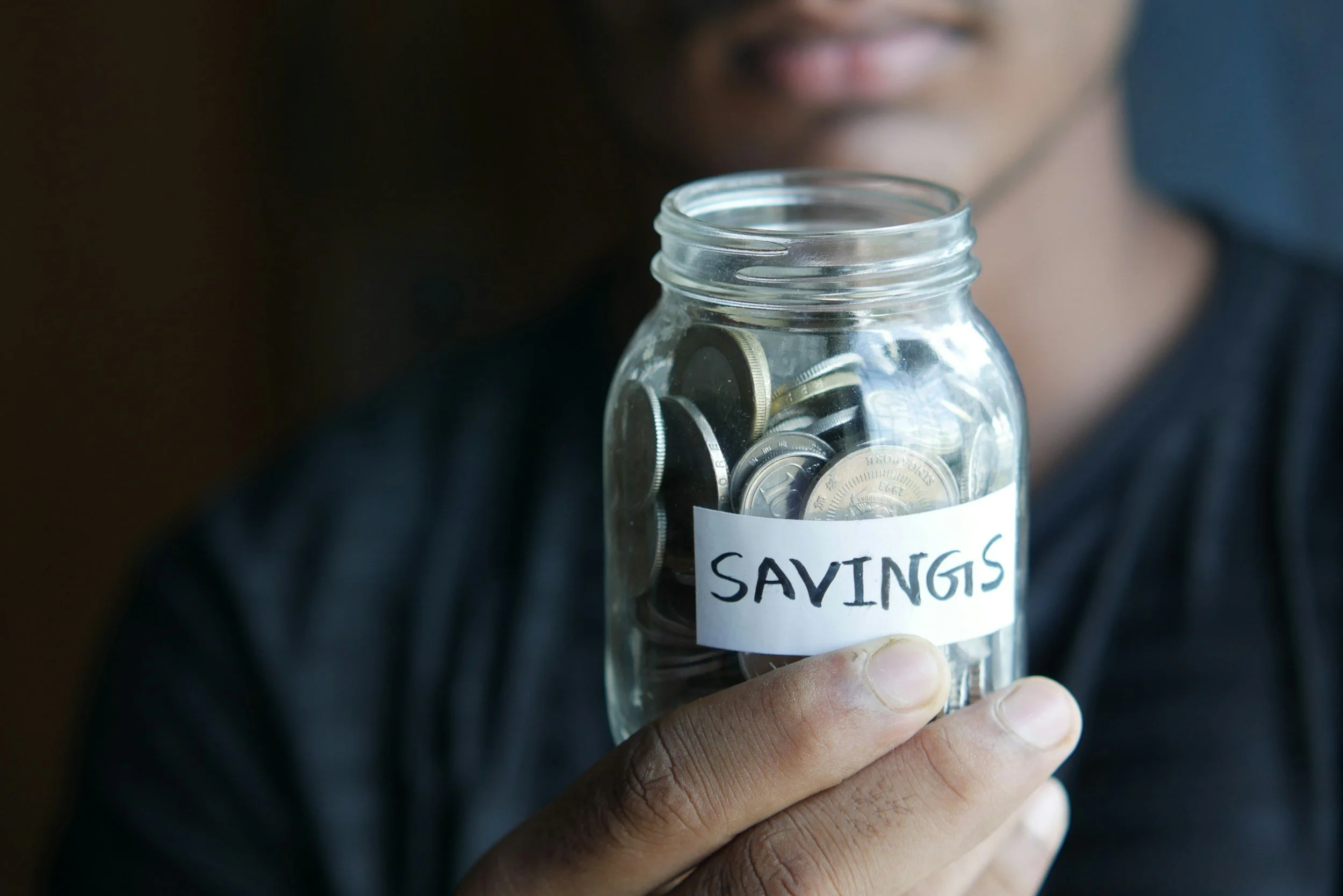
First of all - a cushion
Before saving 3 to 6 months in expenses in a high-yield savings account (which we will certainly come back to later in this post), let’s talk “cushion.” I’m surprised that more of the wisdom shared and published about financial management doesn’t discuss this fundamental concept. A cushion is an amount you leave in your checking account so that when you make a miscalculation, you don’t find your bank account overdrawn and incur overdraft fees for insufficient funds. It is critical not to pay fees that are avoidable on your wealth journey. Paying avoidable fees is wasteful and is a transfer of your wealth to that of someone (or some company) that is already extraordinarily wealthy. Perhaps more important, playing chicken with your checking account is stressful. A financially wealthy mindset is one of peace, calm and equanimity. This mindset enables us to focus, to see opportunities and pitfalls and to navigate the financial landscape successfully. Financial stress oftentimes leads to shortsightedness. So don’t play chicken with your checking account. Instead, leave a cushion!
The cushion should be a set number you leave in your checking account and it should be either a $100, $1,000 or a multiple of $1,000 (i.e. $3,000, $5,000, etc.) The reason for the rounding is that it needs to be a number that stays in your mind and is very easy for calculation. For example, if your cushion is $1,000 and you have $2,335 in your checking account, you know that you have $1,335 available to spend. See how easy that math was? For those of us currently living on the edge, start with $100. Then work your way up to $1,000. I would advocate that in time, you grow the cushion to an amount that covers your essential expenses. The six essential expenses are (1) Housing, (2) Groceries, (3) Clothing, (4) Healthcare, (5) Transportation and (6) Communication. If those expenses all add up to $4,000, that is an ideal amount of cushion to keep in your checking account. Again, the purpose of these funds is to avoid playing chicken with your checking account. This behavior prepares you for “rainy days” caused by timing snafus (your automatic mortgage payment was extracted before your paycheck was direct deposited), whoopsies (you forgot about the credit card payment you made and now that the amount has been debited from your checking account, there is not enough money for the electric bill payment to clear) and miscalculations of any kind. The checking account cushion is an essential part of saving for a rainy day.
..next, Reserves (“or set-asides”)
Now that you are no longer playing chicken with your checking account, it’s time to set-aside funds that will avoid “creating our own emergencies.” Here are a few examples of emergencies we create, but could avoid:
Uh oh, the auto-insurance bill, which get’s paid every six months is now due
Uh oh, the annual property tax bill is due
Uh oh, the car registration needs to be renewed
Uh oh, I took the car for an oil change and it turns out I need new tires and new brakes
Uh oh, it’s the holidays and I need to buy presents for my parents, children, nieces and nephews and siblings
Uh oh, my drain is clogged and I need to call a plumber
Uh oh, I need a root canal and a crown and even though I have dental coverage, I still have to pay $400
These are only financial emergencies if we are not prepared for them. Three of the examples above are auto-related and if you own a car, you WILL need to pay for auto-insurance, renew your auto registration and replace tires and brakes at some point. If you own a home, you WILL encounter necessary (and periodically urgent) repairs. If you have a body, you WILL encounter uninsured health care costs. As such, it is essential to “reserve” or “set-aside” funds for these inevitable expenses.
Ideally, open up a high-yield savings account with an FDIC-insured bank for these reserves and set-asides (a “reserve” account). Incorporate these reserves in your monthly budget and each month, transfer the budgeted reserve amounts into the reserve account. By doing this, you have avoided creating your own financial emergencies!
…and do prepare for actual emergencies
Indeed, there are emergencies that we can’t anticipate. Recently, we had a roof leak and it turned out that our roof was in need of some repair. Fortunately, the cost of the repair was very reasonable and full replacement of our roof was not necessary. However, I had not anticipated that racoons had taken up lodging underneath the solar panels and indulged themselves on a diet of our roof shingles. The replacement of the shingles was inexpensive, but the removal of the solar panels to make the repair and the subsequent replacement of the solar panels (which had to be done by a special solar panel technician) was unanticipated. As much as we try to anticipate the costs of our lifestyles, there will always be surprises. This is one of the reasons we are advised to keep an emergency fund of 3 to 6 months of expenses available.
Sometimes, the surprise is an interruption of income. This is the “why” behind the 3 to 6 months emergency fund. Ideally, we’d be able to sustain our lifestyle without interruption while it takes 3 to 6 months to replace the income. There are many scenarios where 3 to 6 months might not be enough. For example, if you work in an industry where it may take longer to find a new job or if you will benefit from the flexibility of waiting a little longer for a job that might be a better fit. In those cases, saving about a year’s worth of expenses might be more appropriate.
If it seems intimidating to imagine saving up a years worth of expenses, or even three months, just start where you are! Start with $25 or $100 or whatever you have available to you and build from there.
Open up a high-yield FDIC-insured savings account. Call it your “emergency” account. Ideally this one is separate from your “reserve” account. The reserve account is for very specific expenses and there will be withdrawals; several each year. Ideally, withdrawals from the emergency account are very seldom. Set up an automatic transfer to this account from your checking account. Start with $25 per month if you are not able to put more in yet. But set a target dollar amount for the account and prioritize funding that amount. For example, if you have $4,000 in monthly expenses and you are targeting 3 months expenses, then target $12,000 and consider ways to get it funded. Perhaps you can take a break from UberEats, save $200 per month and starting putting that in your emergency account. Perhaps, when you are the recipient of bonuses or birthday gifts, you can use a portion to fund your emergency account. Don’t forget to celebrate each deposit!
…and enjoy the peace of mind.
Don’t wait until you have a cushion, adequate reserves and a fully-funded emergency account to enjoy peace of mind. Once you are actively preparing for the surprises that will certainly occur, you may notice a well-deserved sense of peace because you are walking in financial health. Financial health is not a destination, it’s more of a direction.
So enjoy the feeling that comes along with embarking on a journey of financial health: A sense of financial wellbeing!
wellbeingGrant